Showing posts with label MinorityInGeek. Show all posts

Thursday, September 26, 2013

Minority in Geek: The Banality of Evil

by Jeff Bartlett

The time has come to wrap up the Minority in Geek project that Aine Lauren and I started a year ago. When we started, the project was called Misogyny in Geek and we wanted to target issues related to sexism in geek culture. Then every geek website on the internet got in on the game. We decided that if DC Geeks was going to be the community we wanted, it couldn't follow sites. It had to blaze trails. And sadly, geek culture wasn't only alienating women.
From the Tumblr, Cosplays with Color,
Pro Bodybuilder Robin Johnson Jr. as Supes

Our change in focus was fortuitous, because what a year it has been. The Supreme Court handed down a landmark gay rights ruling in United States v. Windsor, striking down Section 3 of DOMA; George Zimmerman was acquitted of killing Trayvon Martin; and geek fare like Iron Man 3 and Pacific Rim made subversive efforts to redefine the role of women in pop-culture. While the stories have not always been positive, this has been a year for the history books with regard to America's evolving attitudes towards minorities.

Before getting into the meat of our topic, I would like to say I am very proud of this project. I actually contributed very little to it. Lauren, Aine, and I thought we would need to write an article each per month, but we were flooded with guest authors dying to take the topic on. We've had articles on sexism directed at cosplayers, the “fake geek girl” phenomenon, being a furry, being the token black friend, and being transgendered. The talent that came forward to contribute has been humbling, and we are deeply thankful. But for all of the amazing articles we posted, I am glad that this project is ending. I am not sure I want to read another article on the topic for a long, long time.

So why am I done with this project? Well, first, it is important to understand what we achieved. What tied most of our articles together is that they were written by minorities explaining what it was like being part of their minority within a geek minority. They explained why being the internet’s perpetual punching bag, why being identified as a "token," why being accused of being inauthentic hurts and diminishes them as individuals. After reading these stories month after month after month, it is apparent that geek culture as a whole has a real problem with minorities. And that, to me, is shocking. But that does not make it any less true.

I remember a moment that really opened my eyes to the world and to the privilege I enjoy within it. In college, I was speaking to my wife (then girlfriend) who told me that every time she walked to the bus station, she passed a group of men that catcalled her. This blew my mind. I had never seen men catcall anybody.

Catcalling seemed like an absurd historical artifact. It was lampooned in 1950's Warner Brothers cartoons, for crying out loud. I stared at her, mouth agape, unable to believe that happened. Then her roommate confirmed it, and said the same thing happens to her. It turns out it is was a common, near daily occurrence for all the women I knew who walked anywhere, and had been since adolescence. Seriously. Grabbing your junk and screaming at women “hey baby, how about you ride my love python?!” Who does that? It’s so… pathetic. And, as all my female friends told me, the reason I was so stunned is that, for whatever reason, the catcallers never do it when a man is around. Knowing this made the world suddenly a darker place. The idea that most people are inherently good became that much harder to hold onto.


Copyright Warner Brothers. Wolf by Tex Avery
The Minority in Geek project is a steady dose of the same lesson. When I grew up, I was living with my father who served in the US State Department. I grew up living abroad. I moved every three years, which meant no long term friendships. It also meant that I was a pretty lonely and isolated kid  perpetually a cultural, racial, and language outsider. Geek interests were tremendously important. Role-playing games like Dungeons & Dragons helped me make tight (if small) groups of friends with whom I could socialize on a regular basis. 

The pluralist utopian vision of TV shows like Star Trek: The Next Generation helped give me a frame of reference for experiencing the countries I was living in: not as frightening places hostile to Americans, but as rich, deep cultures. My life exploring them was recast as a grand adventure. Geek was a place where everyone was welcome, no matter race, creed, national origin, gender, sexuality, what have you. Geek culture was the Star Trek utopia in our real world. Coming to find that it is anything but has been heartbreaking.

To paraphrase Wil Wheaton, I understand geek culture to be pretty simple. It’s not what you love, it is how you love it. All you should need to create geek community is to say “You love this? I love this too! Let’s love this together!” But Minority in Geek has taught me that this simply is not the case. I've spent some time rolling it about in my head, trying to understand why all of the sudden, starting around 2012, my beloved community had become so intolerant of others.

Have the bullies of old made their way into our world now that geeks are no longer the put-upon minority that had, historically, been predisposed to compassion after our experience with prejudice? Or have we always been like this? Have we (the white males that appear to be the majority of geek culture) only been waiting to take out our frustration on a subgroup that was more vulnerable than ourselves?

The answer, of course, is neither of the above. Because the phenomenon is not new. Last month I read this blog post over at Popehat (a law blog by gamer nerds), and I read this: 
“Disproportionate anger at discussions of the topic of harassment — seems particularly pronounced when people discuss bad behavior within the wide spectrum of what I'll call ‘geek culture’ — science fiction, computer gaming, pen-and-paper gaming. For some time I've talked about the thoroughly creepy undercurrents in that culture. I've observed them for decades. I remember going to gaming conventions as a teen in the early 1980s and seeing how some men, seemingly freed from manners by the context, openly leered and touched [and] made comments that should have gotten them kicked in the nuts. I vividly remember a tournament pen-and-paper game (maybe Paranoia?) in which players' comments to the one woman got increasingly ugly until she pushed her chair away and left, leaving the remaining men to complain bitterly that she was a bitch with no sense of humor.” 
Believe it or not, this made me feel better. Because while it means that I have been naive in my ignorance of the phenomenon, it is not new. It has been with us for as long as we have been a hobby. What is new is that we are talking about it. The trolls can no longer hide safely in the shadows of their victims’ shame and discomfort.

The Darkness - Legend. Also, not real.
This leads us into the blog’s title, and my final thoughts on this project. The “banality of evil” is term used to conceptualize a broad concept in moral philosophy and social psychology for application in political science. As defined by Hannah Arendt in her book Eichmann in Jerusalem, the crux of the theory is that the great evils in history, such as the holocaust, were not the acts of fanatics or sociopaths but instead of ordinary people like you and me who accept the premise of their state and therefore participate in the atrocities with the view that their actions are normal. 

Applying the same idea to geek culture, and even mainstream culture, it is not Evil people who grope women who cosplay, call people names like “fag,” or “cunt,” or “nigger” in online gaming, or beat up on transgendered individuals as “tranny freaks." They do it because their behaviors are so commonplace and so tolerated that the actions are assumed to be normal. Therefore, they do not see their actions as deviant. 

Most people are not moral thinkers and so take their cues regarding right and wrong from context. But when forced to grapple what they have done, they often realize, with sickening guilt, the terribleness of their choices. The value of the Minority in Geek series is not that it offered solutions to our social problems, but that, while it may make us uncomfortable to read these stories, they make abundantly clear that these behaviors are no longer acceptable. By raising the consciousness, we begin to shift what our community defines as acceptable behavior. As these new attitudes filter through geek culture, the people who engage in bad behaviors will become rarer and rarer, until they all but disappear.

George Saunders - Damon Winter/The New York Times
So what are my thoughts on going forward? Only this. I have made mistakes too. I have made women uncomfortable. I have been too handsy. I have jokingly referred to my minority friends as “token” or “my nigga.” Even typing this words is difficult, and makes my face flush. Because they bring me great shame. George Saunders wrote “What I regret most in my life are failures of kindness.” This resonates with me. I know that when the day finally comes that I stand face to face with my own mortality, my regrets will not consist of roads not taken, jobs turned down, adventures missed. What will eat at me, and they all still eat at me, will be my failures of kindness. 

Saunders went on to say he regretted the moments “ when another human being was there, in front of me, suffering, and I responded…sensibly. Reservedly. Mildly.” So as we lay this series to rest I charge you with the following: As you go out into the world, be not mild. Whether you are at a convention, or a restaurant, or a friend’s house, and you witness one person putting down another for anything other but the content of their character, speak up. You don’t need to be confrontational, you don’t need to start a fight. It can be as simple as saying “hey man, that’s not cool.” All you have to do to make a better world is change what we accept as normal. What we call human nature is often little more than human habit.

Thursday, July 25, 2013

On Bullshit (and Furries)

by Pres. James

“Wait... you’re a furry?”
My friend visibly recoiled with the question, a friend who had hung out with me for months at college and gamed online with me for years before that. Was I going to lose a friend over something so stupid?
I had to say something, “Well, yeah, but it’s okay! I’m not one of the creepy ones!”

Oof. Yup, that just came out of my mouth. Insert a mental facepalm here. I knew someone well enough to potentially change their mind, and that's how I chose to represent all my furry friends.

Thanks, brain. Thanks for that.
(image by jahofker)

I unintentionally found the furry community when I was fairly young, through a high fantasy chat room I discovered back in the early, early days of the internet. The community has been a part of me for quite some time, just as I’ve been a part of it. I’m a well rounded individual with friends from both within and without that particular fandom, as are most of the other furries I meet.
The community tends to draw a younger crowd, which unfortunately creates something of a self-perpetuating cycle. New furries inevitably run into the harassment that suffuses the net, and react strongly. Bullies and trolls love to get under someone's skin so easily, giving them incentive to continue the harassment.
Eventually, furries tend to split off into one of two crowds. Those who stay learn to simply laugh it off and enjoy what they’ve found. The others leave the community because the harassment becomes too much. I had one friend disappear for just that reason, lost to the internet forever.
In case you've been living in a monastery, or somewhere only serviced by Comcast, you're already aware that furries have something of a PR problem.
As Aine referenced in her April article through this xkcd
comic by Randall Munroe (CC BY-NC 2.5)
 
Okay, less of a PR problem, and more that we’re the people the internet loves to hate. Although the comic is from half a decade ago, the stigma persists. The constant reminders of what the "world" thinks can become internalized, as you can see from, "I'm not one of the creepy ones."
But, you start to think - even if subconsciously - that even if you and your friends aren't this way. But what about the rest of the community? They must be "the creepy ones." Why else would everyone continue harassing us? People keep saying "stereotypes exist for a reason."

Which is bullshit, of course, but that’s human psychology for you.
So while I am many things – a GSM, a member of the kink community, a hacker – the thing I’m most reluctant to reveal is that I’m a furry. I don't make a big deal about it, and when it comes out, it comes out. The most common response is, "But you seem so normal." The comment isn't meant to be malicious, but it's certainly not a compliment.

The xkcd shows tolerance of those who are "weird as hell"
rather than full acceptance of an unfamiliar subculture.
(image credit unknown, email the editor if you own this image).

Lately, things have been getting easier for furries. Is it that people are becoming more accepting? Is the furry community more visible because we've grown so much in the past years? Could normalization be due to increased visibility?

Nope. Unfortunately, it seems the heat has been taken off of the furries, because the internet’s new favorite target is bronies. I've even seen some furries celebrate, happy that there’s finally someone that the internet hates more! And that, my friends, is also bullshit.

As with most "Minority in Geek" articles, it's tempting to close with, "Look. We’re all geeks." Geek culture should unite us because, to quote Simon Pegg, "it means never having to play it cool about how much you like something." This time it's deeper than that. As a decent person, when you see another being harassed, your reaction shouldn't be, "at least it's not me." But even that is too simple.
The problem isn't only the bystander mentality of "at least it's not me;" it's complicated with the stigma of confronting one of our own. In some ways, geeks (and furries) are starting to battle a serious challenge of being an accepting community. And it's that while being accepting and inclusive is wonderful, it creates an environment where toxic people are difficult to remove. People want to be accepting, so "that guy" or "the creepy dude" are left without anyone willing to confront them, which may be why Captain Awkward gets so many letters about them.
I'm sure someone else has said something
about his "creepy dude" vibe...
(image by Terry Robinson)

Meanwhile, furries are caught in all the crossfires. The community is so accepting that creepers are left alone to smear our reputation. We've stood alone for so long against constant harassment that many furries feel no need to step up to defend bronies. All the while, we're busy hiding or downplaying an entire facet of our identity to everyone not involved, which is especially frustrating because these problems are in no way unique to the furry subculture.
Instead of having young geeks and furries learn that in order to join your community, you must have sufficiently thick skin to avoid getting harassed, can we admit that we do have bullies within our all-inclusive geek culture? Can we learn when that tolerance has gone too far, admit when someone has taken advantage of our acceptance, and gather the courage to confront even other geeks?
Because right now, we have geeks being flamed to pieces online and yet they still feel it's worth it to remain closeted to their other geek friends. It can feel that because your harassers are other geeks, there's no guarantee that your friends would take your side. The "I'm a furry/brony" admission is so uncomfortable and stigmatized that it's often just simpler to face a flame war alone.
And that's bullshit.

Friday, June 7, 2013

Death of the Token Black Friend

By Scooter
I don't mean to be racist, but...
(Image © by Ibra Ake via SD City Beat)

I'm black and I'm a geek. I'm sorry if that makes you uncomfortable.

I've made a playlist to go with this article. It's one song on repeat, "Bonfire" by Childish Gambino. Check it out, especially around 2:03. Also relevant is a GIF-filled BuzzFeed article talking about 27 Things You Had To Deal With As The Only Black Kid In Your Class. I guarantee you that almost every black geek in your social circle or who you've run into at a con knows that feel, bro.

Something that happens frequently for blacks within nerd culture is being the only black in a room full of whites. The concept of the token black friend isn't foreign to most people. I still hear it often. In fact just last weekend, this phrase was used in reference to me by some close friends. My friends aren’t intentionally offensive, but they seem to need to draw attention to a situation that they find either funny or awkward.

People seem to believe that having one non-white person somehow proves that there is nothing wrong with the situation: the persons at the event are not pushing people away for not being white. Having a friend of another ethnicity is proof they are modern, and of course could not be that dreaded word, racist.

Following Neil deGrasse Tyson's Twitter doesn't make it ok
(Image © unknown, via Reddit)
This comes up a lots when gaming or drinking with friends, especially ones I've had for a long time. I've asked for clarification when people mention that I'm the only black person a party or call me their token black friend. Most often I hear, "Oh I'm just playing, it doesn't matter." or something similar. Yet I get looks that show how uncomfortable people are that I’m there. I think that the problem is that when people are unable to face this discomfort and tension, the feelings spill out into comments like, "You're my favorite black friend... you're my only black friend."

In a culture that’s based on shared passion, why bother to point out that I’m black? Why does my appearance matter so much that it's brought up frequently? I know people don't mean anything malicious by it. But what does it says in general if being black in geek culture is so strange that we feel compelled to call attention to it every time? I wonder how many kids have walked away from one geek group or another from this feeling of alienation.

The real problem here is that it makes blacks feel like they are foreigners who are only begrudgingly accepted by the rest of the geek community. Whenever this difference is pointed out, it labels us as outsiders and shifts the focus away from the common interests that brought us all together in the first place: our love of shit. The obsessions that we loved so badly that many of us were ostracized by mainstream culture. The things that caused us to bond together as a community in the first place.

(Empire Strikes Back is © 20th Century Fox, image via MTV Movies Blog)

Don't get me wrong here, I'm not against answering questions about being black or racial relations. I don't mean that we can't all come together and have these discussions, but let's not start from a place of our differences. Please, just keep in mind, that when you call a black person in any mostly not black group a token, what they may be thinking is, "Am I only here to provide you with diversity?" It implies that you are talking to them or befriending them merely so you can have a black friend, regardless of any other part of their identity.

It's a difference in focus, but an important one.

Friday, May 10, 2013

Trans* Shouldn’t Be the Worst of Both Worlds


By Aine C.

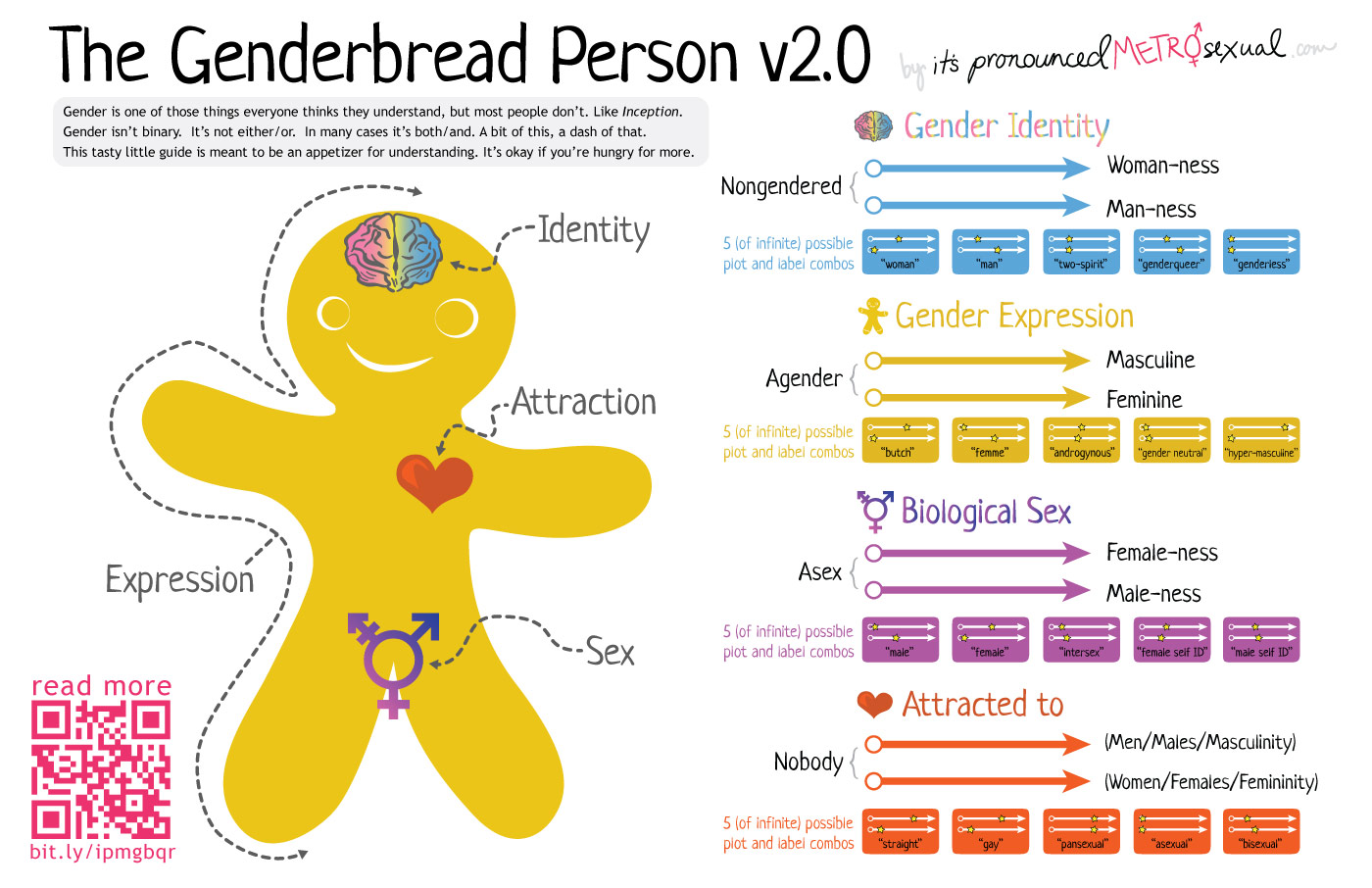
I’m dating myself a bit here, but we didn’t have the term “ally” when I was in high school or even in college. And when the second link on a Google search for "trans* gamers" is a rant about whether a male should ever be allowed to choose a female avatar (regardless of the guy's gender identity, orientation, etc.) I feel like a bit of 101 is in order.

The full size of the graphic below is worth a read, as is Killerman's blog, and the Wikipedia page on Transgender isn't bad (far from comprehensive, but it's getting a lot better).

My use of “trans*” means I don’t want to leave out anyone along the spectrum.
(Thanks to Sam Killerman for the excellent visual.) 

A few years ago, Eve began revealing to our social circle that she was female. I let her know that I wanted to be supportive, but I wasn't sure what that meant. Even after knowing Eve for nearly 15 years, I reverted to the Southern tradition of being civil and keeping quiet. I tried to learn as much as I could on my own and online, but the thought of actually asking her about what she was going through seemed somehow rude.

‘Cause if there’s one thing that helps an issue, it’s silence, right?

When I finally asked, I was heartbroken to learn it was worse than I'd realized. For example, Eve has had a drunken ass stumble up to her and yell to everyone around that she couldn't "fool him," followed by a rant about how he didn't "believe in transgendered people." We discussed even more cringe-worthy stories about how people think it's completely acceptable to strike up a conversation about her genitals, and refuse to let her self-identify unless her bits meet their specifications.

Eve described how, even within the community that claims to support LGBT rights, there is a significant amount of transphobia (which is why I prefer to use GSM). The heart of their argument seems to be that anyone who wants to be trans* must be chasing passing privilege. That’s before the trans* vs trans* stigma over whether you express your gender through clothing, binding, top surgery, bottom surgery, hormones, etc. When the goal, as Eve puts it, should never be to mimic hetero life. The goal is to “feel whole as you are” without the agony of dysmorphia.

I asked what online gaming must be like after getting a pretty rough look at the IRL harassment, or as Eve put it, “the argument that never ends.” Eve explained that the challenge starts right from the character select screen, where players pick a binary gender option, if they're given a choice at all. Now, I’ve seen the vitriol on Reddit, but Eve’s a League of Legends player – not exactly a game known for its fluffy, tolerant community.

(as the watermark says, rage comic via League Meme)

When I asked how bad it was, her reply shocked me only slightly, “I don’t come out as trans*. I try to pass for a woman online... but no matter what character type you choose, everyone assumes you’re male.” When Eve corrects them, the consensus is usually shock and disbelief, "But you’re good!”

So Eve has to deal with all the misogyny we’ve covered in this series that’s just part of being a female gamer for now, rather than risk the backlash of coming out as trans*. Before I could really let it sink in how incredibly disheartening that is, she explained her strategy for dealing with the misogyny:

“I’ve been hardened enough to be confrontational. I find strength and catharsis, because if you’re rude, my new goal is to wreck you [for as long as we're both logged in].”

How do you feel now, Rockstar?
(image © Alan Sailer)

I’ve heard this echoed in friends from pro-gamers, to WoW and LoL enthusiasts, to security professionals – the only way to be accepted as a woman for now is to be better than everyone else. Sadly, that’s not within everyone’s reach. I’m never going to be the best raider on WoW or the twitchiest shot in Team Fortress 2. In some ways, I feel like I’ve been waiting for badasses like Eve to blaze the trail before it’s safe for gamers and geeks like me to come out of hiding. 

What if I didn’t? What if none of us did? I wonder if the mindset could change with the demographic, even if we had to put up with a period of loud, abusive rants about how it’s ruining the hobby or culture. Think we could flood the servers of whatever multiplayer games we’ve been hiding from and just play for the joy of playing, gender be damned?

Thank you, Eve, for being willing to share your anecdotes. For those of you interested in contributing stories to our Minority in Geek series, please email us or leave a comment below.

Friday, April 19, 2013

Reintroducing the Minority in Geek Series


by Aine C.

Oddly enough, I never intended to write an article about privilege. This started as a simple announcement.


Several months ago, Jeff, who kicked off this series with me and Lauren, suggested a broader focus for the articles. There are moving, eloquent articles being written about misogyny on a very regular basis. The issue is successfully sparking controversy as they drag the discrimination into the light:

We've needed to expand beyond misogyny to include other minorities and subcultures that are often overlooked, misrepresented, or reviled even in what should be the haven of geek culture.


XKCD #471 by Randall Munroe (CC BY-NC 2.5)
You can be an ally, even to people who make you uncomfortable.
At first, I didn't see our initial choice to focus on misogyny as privilege - after all, haven't our English teachers always warned us not to pick too broad a topic? And our decision wasn't about letting go of privilege, it was about being inclusive. But there is not only the dismissal of problems men face, but also dividing us into the two teams of men and women is inherently cissexist. And intentionally or not, unthinkingly promoting the gender binary, is evidence of privilege.

In the same way that "internalized misogyny" hit me hard when I finally understood it, the phrase "invisible privilege" initially didn't resonate with me immediately. I'd only heard it applied to the "Invisible Privilege of the Christian Majority" and I was too busy being outraged about how They were unaware of how good they had it, while acting all oppressed! Recently, I've finally begun to examining privileges that I take for granted. I'm beginning to grok how all privilege starts off as invisible, and how distressing it can be to consider letting go of it.

I cling to privilege. But, if I have all these benefits in society that I didn't earn, what can I do? I didn't ask for this? How do I give it back? Well, I can start by trying to regain that fearless honesty I once had about myself instead of just breathing a sigh of relief when I “pass” (i.e. someone incorrectly assumes I’m “normal like them”). I would have to return to being honest, even if it costs me another round of fair-weather friends.

(photo by Carlos Castillo)
Mind if I take these off?
It's getting a bit stuffy. 
I know I'm not the only one who denies huge swaths of my identity, hoping I'll magically change, because it would be so much easier to deal with the world as a heterosexual cis-female feigning agnosticism. So it’s equally likely that I’ll strengthen relationships with people who are also trying to hide in plain sight. There have to be other Secret Agents (obligatory Melissa Etheridge link with autoplay warning).

I've run into my own doublethink and hypocrisy in other ways as well. I'll scream until I'm hoarse about how Cosplay IS NEVER Consent and I’ll lament the severe body-shaming that crawls along that subculture’s darker side, but I stopped cosplaying nearly a decade ago to avoid ridicule. I've raged about the accused fake geek girl, but I've rarely had someone question my cred; I lucked out and found geekdom through a university organization that was thrilled to have a female member who was a Zelda and Mario fan.

The issue becomes far more complex as geeks because many of us were ignored, bullied, and hated for our hobbies. I had my high school threaten call the police because, even though I hadn't even had so much as a demerit on my record, being depressed and nerdy meant that one rumor was evidence enough that I was the next Dylan Klebold. Because it was a Christian school hopped up on the mid-nineties Satanic Panic, my borrowed Monster Manual nearly started a witch hunt when I was ordered (and refused) to provide a blacklist of every student who played Dungeons & Dragons. I believe the scars from that time still run deep for many of us, but our childhoods will never justify harm we cause as adults.

Facepalm from the IT Crowd
(© Channel 4) via Cheezburger
Unfortunately now, it seems like geekdom is actively trying to reverse the privileges of mainstream society by discriminating against the people whom they assume have it easier. I've seen us dismiss would-be fans with a sigh and "Oh well, you can't expect him to understand us, he's a jock." It's the same problem with every fake (read:attractive) geek. Every exclusionary comment boils down to "I was bullied. He is attractive and obviously hasn't faced my hardship. How dare he take our word - that's as bad as using racial slurs."

Meanwhile, racial minorities actually are being discriminated against and are frequently under-represented in games. John Kovalic braved the discussion of race in gaming with a series of Dork Tower strips back in 2010. A few months later, Stanley Woo (representing BioWare) was raging on their official forums that no one had disliked the Dragon Age due to racial homogeneity, and that the company shouldn't be forced to have dark skinned people "just to be fair." A second statement quickly amended his statements with, essentially, “aaaaah, ummmm, there ARE dark people, they just, um, live up north, and the game takes place in the south, so you probably just didn’t see them.”

In contrast, lesbian, gay, and bisexual characters are making their way into games (sadly, trans* individuals get thrown under the bus, despite their inclusion in the acronym - but that's another article). Yet sometimes things go horribly awry, as with BioWare and the DLC Gay Ghetto of the Old Republic. If anything it's proof that good intentions aren't enough to get by on anymore. Oh, and maybe don't prioritize the ease with which you manage DLC over bigger issues like how your consumer base may dwindle as your brand is seen as rejecting the LGBT community. At least we still have Dragon Age and Mass Effect.

(Mass Effect © BioWare via GayGamer)
Ouch, Liara, don't be so surprised.
Sadly, although we have a few gay and lesbian characters, and even some non-white characters, all the rest of the Gender and/or Sexual Minorities (GSM - an acronym I far prefer to LGBT) and others are still queued behind, hoping that one day they'll be included too. Hopefully, it will snowball, and we’ll all pull one another up and find recognition, especially as it becomes more feasible to make complex games where the player can create a character with whom they truly do identify.

With the ratings system (if it's as fucked up as the one for film), I wonder if developers’ hands are tied. I don't want graphic sex scenes incorporated into every game, but right now threesomes and other non-monogamous relationships are treated like an easter egg or a nude mod. Often they are brief, nearly-impossible to trigger, once-a-game, scandalous events. Sorry poly folks, I tried searching for "polyamory in video games" and the closest match was some kid blogger using the word to be edgy because he was (gasp!) playing two video games at once. Depressingly, games with healthy non-monogamy are a long way off.


The take-away here is that women are far from the only minority that need better representation in geek culture. So this article series has to grow beyond its original focus to include GSM (transgendered, transsexual, trans*, questioning, queer, asexual, demi-sexual/grey-asexual, bi-romantic, pansexual, dualgendered, gender fluid, genderqueer, and everyone else), post-humanists, furries, otherkin, polyamorous, non-monogamous, non-Caucasian, non-nerd-seeming jocks, and women. That's by no means an all-inclusive list. Those are just people I've seen used as internet punching bags over the past year, which may be why it's so skewed towards the non-heteronormative crowd.


It's heart-wrenching that this statement is considered radical.
(image by DCTim1)

Therefore, we're accepting submissions. If you would like to contribute to this series with anecdotes, opinions, etc. please drop us an email, and we’ll give you more details. If you’d like to remain anonymous, please let us know. As always, please feel free to discuss in the comments section below.